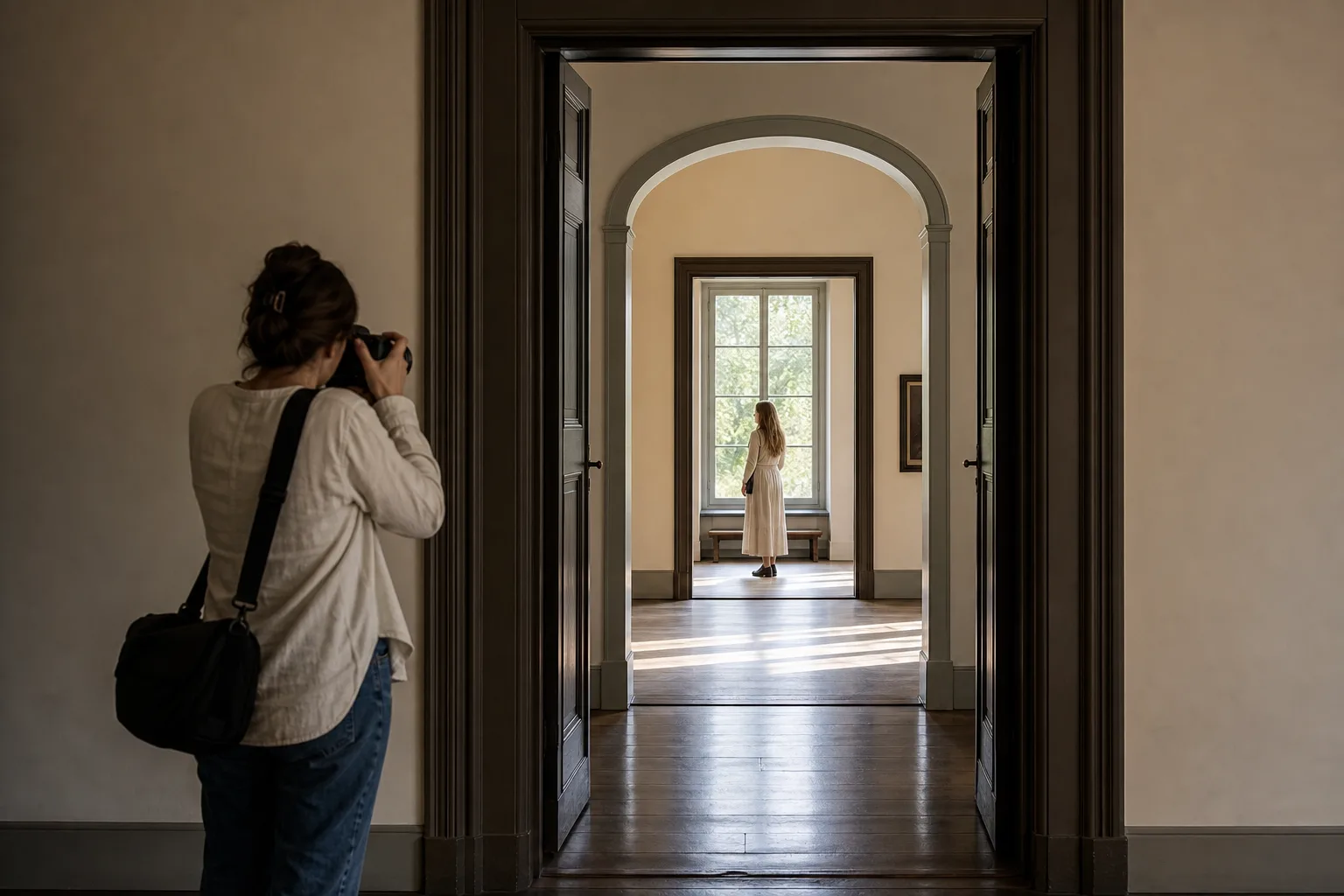
A practical guide to framing stronger photos with cleaner edges, intentional subject placement, foreground layers, visual boundaries, and frame-within-a-frame composition.
To frame stronger photos, decide what the viewer should notice first, then clean the edges, use boundaries only when they guide attention, leave purposeful space, and build clear foreground, subject, and background layers. Good framing is less about adding a border and more about making the visual path obvious.
Strong framing guides attention before the viewer has time to think about composition rules.
Quick framing checklist
Name the subject before choosing the frame.
Check all four edges for bright distractions, cut-off limbs, poles, signs, and awkward crops.
Use doors, windows, arches, light, shadows, people, trees, or foreground shapes only when they help the subject.
Place the subject with enough space for gaze, movement, mood, or symmetry.
Separate foreground, subject, and background so the photo has depth without clutter.
Take one safe frame, then move a little closer, lower, higher, left, or right to improve the boundaries.
Clean the edges first
Frame edges often decide whether a photo feels intentional. A strong subject can be weakened by a bright patch at the border, a pole growing from a head, a half-cut hand, or a distracting object near the corner. Before pressing the shutter, scan clockwise around the frame and ask what each edge is doing.
Edge problem
Why it weakens the photo
Better fix
Bright corner
The eye leaves the subject and jumps to the border.
Shift position, crop tighter, wait, or darken that area only if it stays natural.
Pole or branch near a head
The subject looks visually tangled with the background.
Step left or right until the head has cleaner space.
Awkward crop
Cutting through wrists, ankles, fingers, or the top of the head can feel accidental.
Crop at more natural places or leave a little more room.
Too much empty border
The frame feels unfinished when the space has no purpose.
Use the space for direction, mood, or balance, or move closer.
Foreground blocking the subject
Depth becomes clutter when the viewer cannot read the main subject.
Use a softer foreground edge or move it away from faces and key gestures.
Clean edges and a calm background help the viewer stay with the subject.
Use frame within a frame
Frame-within-a-frame photography uses something inside the scene to surround or contain the subject. Doors, windows, arches, mirrors, tree branches, shadows, light patches, people, curtains, and architectural shapes can all work. The key is that the inner frame should support the subject, not become a gimmick.
Use doorways and windows when they naturally point toward the subject.
Use shadows or pools of light as soft frames when a literal border feels too heavy.
Let people or objects at the edges create context without blocking the main action.
Keep the inner frame simple enough that the subject remains readable.
Avoid climbing, leaning into roads, blocking walkways, or entering restricted spaces just to get a frame.
Frames within frames work best when the subject, light, and boundaries all feel intentional.
Subject placement and negative space
Subject placement should answer the photo's direction. A person looking left may need room on the left. A runner may need space to move into. A quiet portrait may feel stronger in the center. Negative space can add calm, loneliness, scale, or elegance, but only when the empty area supports the story.
Placement choice
When it helps
Watch for
Centered subject
Symmetry, direct portraits, arches, doorways, quiet moments, and graphic scenes.
A centered subject that feels accidental because the edges are messy.
Off-center subject
Movement, gaze, environmental portraits, travel scenes, and street moments.
Empty space that does not add mood, direction, or balance.
Tight frame
Emotion, hands, details, faces, and scenes with distracting surroundings.
Cropping away context the viewer needs.
Wide frame
Architecture, travel, weddings, events, and portfolio scenes where place matters.
A subject that becomes too small or visually lost.
Layers, foregrounds, and background control
Foreground elements can make a photo feel immersive, but they need discipline. A blurred branch, railing, curtain, shoulder, window edge, or reflection can create depth and guide the eye. It becomes a problem when the foreground hides the subject, competes with a face, or adds visual noise without meaning.
Layer
Use it this way
Avoid this
Foreground
Use a soft edge, leaf, doorway, railing, or person to create depth.
Blocking eyes, hands, expressions, or the main gesture.
Middle ground
Place the subject where the viewer can read posture, expression, or action.
Letting the subject blend into similar tones or busy shapes.
Background
Choose a background that supports the subject with contrast, context, or clean space.
Ignoring signs, bright patches, poles, and clutter near the subject.
Visual boundary
Use light, shadow, architecture, or color to contain attention.
Adding a border that distracts more than it guides.
Foreground and background layers add depth when they guide the viewer toward the subject instead of hiding it.
Framing examples by genre
Genre
Framing move
Why it works
Portraits
Use clean walls, doorways, window light, negative space, and simple background edges.
The viewer stays with the face, expression, posture, and hands.
Travel
Use streets, arches, market stalls, transport windows, trees, and foreground details.
The place becomes part of the story without overwhelming the subject.
Events
Shoot from the edge of the room, frame reactions through people, and keep exits clear.
The photo feels present without interrupting the event.
Street photography
Choose a background first, then wait for a gesture inside the frame.
The scene feels observed and organized instead of random.
Portfolio work
Repeat a few strong framing ideas so the set feels consistent.
The final gallery looks intentional rather than patched together.
Common framing mistakes and fixes
Mistake
What goes wrong
Better fix
Using a frame just because it exists
A doorway, branch, or window can feel decorative but unrelated.
Use the frame only when it points toward the subject or adds useful context.
Forgetting the edges
Distractions near the border pull attention away.
Scan all four edges before shooting a sequence.
Making every photo symmetrical
The set can feel stiff and repetitive.
Mix centered, off-center, tight, wide, and layered frames based on the subject.
Crowding the subject
The image feels tense when space, gaze, or movement is cut too tightly.
Leave room where the subject looks, moves, or emotionally needs air.
Adding unsafe or intrusive angles
A stronger frame is not worth blocking people, stepping into traffic, or entering private spaces.
Work from safe public positions and let the composition adapt.
Reviewing similar frames teaches you which edge, layer, or subject placement made the image stronger.
Choose the strongest framed images
After the shoot, compare similar frames and keep the ones where the subject is easiest to read. Look for clean edges, useful negative space, intentional layers, and boundaries that guide the eye. For related practice, read composition tips for beginner photographers and travel photography tips. Once the final framed images are selected and edited, Gampi can help you organize them into a clean portfolio or gallery without turning framing practice into a delivery workflow.
Present your strongest framed photos
After choosing and editing the frames that best guide attention, use Gampi to organize the final portfolio or client gallery clearly.
Frequently asked questions
What is framing in photography?
Framing in photography is the way you use edges, subject placement, foregrounds, backgrounds, light, shadows, and visual boundaries to guide attention inside the photo.
How do I frame photos better?
Start with a clear subject, clean the frame edges, remove distractions, place the subject intentionally, and use foreground or background elements only when they help the viewer understand the image.
What is frame within a frame photography?
Frame within a frame photography uses something inside the scene, such as a door, window, arch, mirror, shadow, or foreground shape, to surround or guide attention toward the subject.
How do photographers use edges in composition?
Photographers scan the frame edges for distractions, awkward crops, bright corners, and objects touching the subject. Clean edges make the composition feel more deliberate.
How does framing make photos stronger?
Framing makes photos stronger by clarifying the subject, organizing the scene, adding depth, controlling distractions, and guiding the viewer's eye toward the most important part of the image.
A practical guide to using foreground elements for depth, framing, atmosphere, scale, and stronger composition across portraits, travel, street, weddings, events, and landscapes.
A practical outdoor lighting guide for portraits, weddings, events, street photography, and portfolio shoots, with tips for sun, shade, backlight, reflectors, and cloudy days.
A practical guide to photographing through windows, museum glass, cars, planes, aquariums, and storefronts with fewer reflections, less glare, and cleaner focus.