
How to Photograph People Who Feel Awkward in Front of the Camera
A warm, practical guide for photographing awkward or camera-shy clients with trust, clear direction, movement, consent-aware posing, and small wins.
Photography Tips
4 min read

Published June 22, 2026 | 7 min read
To photograph children naturally, make the session feel safe before it feels like a photo shoot. Get guardian permission, keep expectations age-appropriate, choose simple light, let play and routines lead the pace, and use small prompts that give children something real to do instead of asking for a perfect smile.
 Natural child portraits usually happen when the child has space to play, pause, react, and be themselves.
For any child session, confirm guardian permission and expectations before photographing. This is practical photography guidance, not legal advice, and rules vary by location, school, event, family, and final use. When in doubt, slow down, ask, and keep the guardian involved.
Comfort matters as much as light. Children may be shy, energetic, curious, quiet, tired, or suspicious of the camera. None of those reactions are problems to fix. Treat them as information about the pace, distance, and type of prompt the child needs.
 A calm first few minutes can make the camera feel less like pressure and more like part of the room.
Natural children photography works best when the child has a real action to follow. Instead of asking for a smile, build the photo around play, movement, conversation, routine, or a tiny mission. A child who is doing something believable usually gives you more honest expressions than a child being asked to hold still too long.
Choose prompts that match the child's age and mood. Toddlers often need games and quick transitions. Older children may prefer choices, small challenges, or a clear reason for the photo. Teenagers may relax more when you give them agency and avoid babyish direction.
Movement helps photograph kids naturally because it gives energy somewhere to go. Ask for walking, spinning, hopping, reaching, building, reading, or carrying something light. Then photograph the before, during, and after: the preparation, the action, and the reaction are often better than the obvious peak.
 Active children do not need to be stopped every few seconds. Give them safe movement and adjust your settings around it.
There is no single best setting for photographing children because light, lens choice, distance, and movement change quickly. Use these as starting points, then review sharpness and exposure on your own camera.
Situation | Flexible starting point | Why it helps |
|---|---|---|
Quiet indoor play near a window | 1/250s to 1/500s, f/2.8 to f/4, auto ISO | Keeps small gestures sharp while using available light. |
Outdoor walking, cuddles, or calm play | 1/500s, f/2.8 to f/5.6, continuous autofocus | Handles quick expression changes and small movements. |
Running, jumping, spinning, or games | 1/800s to 1/1250s when light allows | Freezes hands, feet, hair, and faces more reliably. |
Sibling or family groups | f/4 to f/8 when depth matters | Gives more room for faces at different distances. |
Low light or fast indoor action | Raise ISO, move closer to window light, or slow the activity | A sharp noisy photo is usually more useful than a clean blurry one. |
For lenses, a 35mm or 50mm can feel natural in homes and small outdoor spaces, while a 70-200mm or moderate zoom can help you stay back when a child needs distance. Very wide lenses can exaggerate faces if you get too close, and very long lenses can make interaction harder. Pick the lens that lets the child stay comfortable.
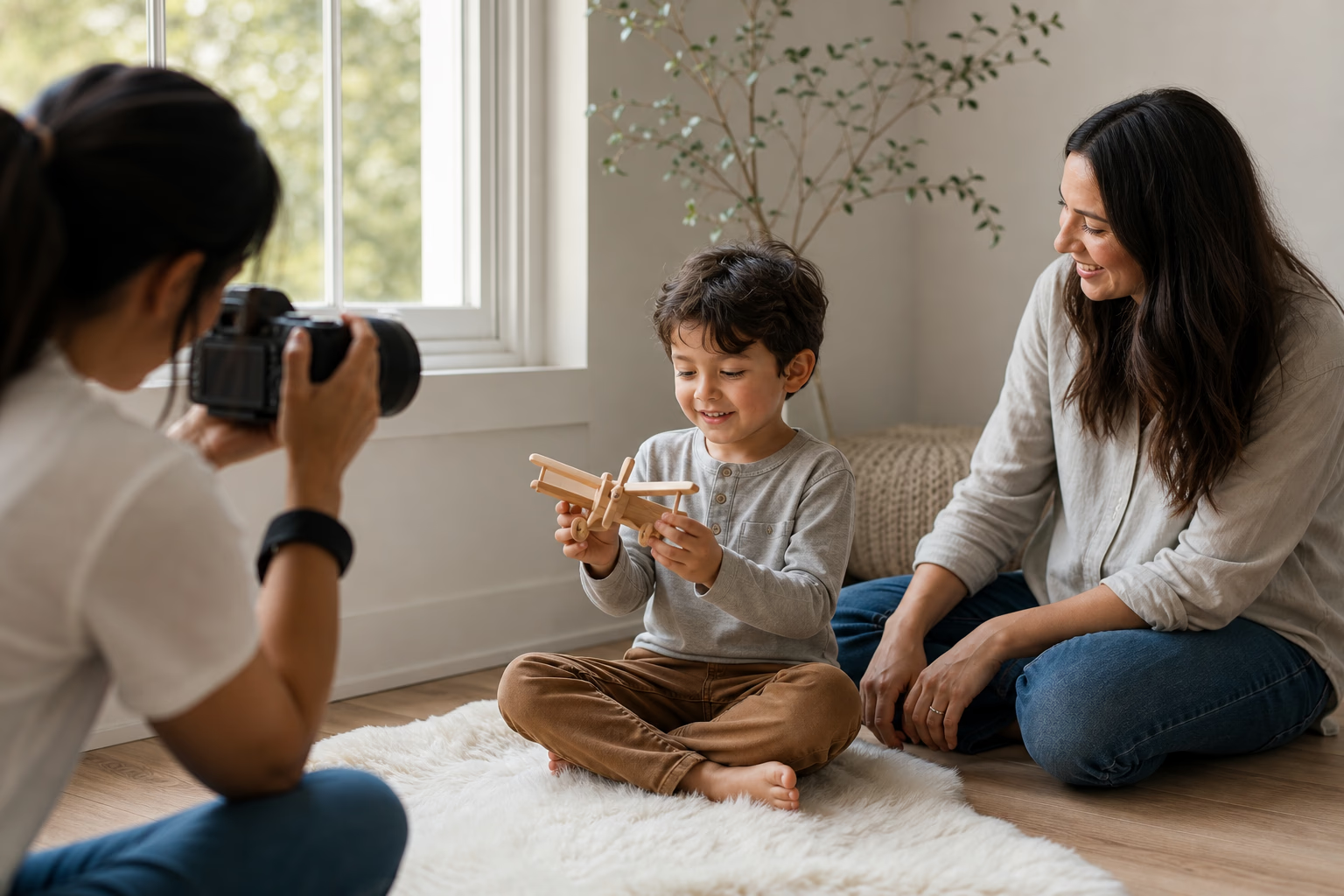 Good child portrait settings protect the moment: enough shutter speed, enough depth of field, and light that lets the child keep playing.
Sibling and family photos look more natural when everyone has a shared activity. Ask family members to walk, build, read, search, carry, sort, or tell a tiny story together. Give the group a task, then photograph the connection that appears around it.
 A shared activity gives siblings and parents a reason to interact naturally without freezing into a formal pose.
Mistake | Why it hurts the photo | Better fix |
|---|---|---|
Asking for a big smile too early | The expression often becomes tense or performative | Start with play, conversation, or a small task and photograph the reaction. |
Holding one pose for too long | Children lose interest quickly and the frame stiffens | Use short prompts and reset often. |
Correcting every movement | The child starts feeling watched instead of comfortable | Adjust your position, light, and timing before correcting the child. |
Using unsafe props or distracting tricks | The photo becomes risky or overstimulating | Keep activities simple, supervised, and appropriate for the child. |
Ignoring shutter speed | Natural movement turns into unwanted blur | Raise shutter speed for active play and use more light or ISO when needed. |
Treating shyness as a problem | The child may withdraw further | Give distance, choices, and quiet prompts that do not demand performance. |
After the session, choose images in passes. First remove clear technical misses, then compare similar frames for expression, gesture, and connection. The strongest child portrait is not always the biggest smile; it may be the frame where the child looks comfortable and the family recognizes them. For more practice, read how to photograph people who feel awkward, how to photograph movement without blur, and how to take better candid photos. When final selects are ready, a clean gallery in Gampi can help families view the finished images without turning the article into a delivery workflow.
After editing, use Gampi to organize finished family photos into a clean gallery that feels easy for clients to view.
Create a safe, relaxed environment, get guardian permission, let the child warm up, use play or routines instead of stiff posing, and photograph real movement, reactions, and quiet pauses.
Natural smiles usually come from comfort, timing, and interaction. Use simple games, conversation, movement, sibling prompts, or a guardian's familiar voice instead of demanding a smile on command.
Use flexible starting points. Try 1/250s to 1/500s for calmer moments, 1/800s or faster for running, f/2.8 to f/5.6 for single children, f/4 to f/8 for groups, and auto ISO when light changes.
Use a faster shutter speed, continuous autofocus, enough light or ISO, and short bursts for unpredictable movement. Review the eyes, hands, and feet to see whether the shutter speed is fast enough.
Keep the guardian involved, explain the session simply, avoid pressure, give choices, start with distance, use short prompts, and take breaks before the child becomes overwhelmed.
A warm, practical guide for photographing awkward or camera-shy clients with trust, clear direction, movement, consent-aware posing, and small wins.
Learn how to take better candid photos with practical observation habits, timing cues, flexible camera settings, respectful distance, and a simple checklist for real moments.
A practical guide to natural pet photos: calm setup, window light, pet-level angles, dog and cat movement, autofocus, owner help, and humane pacing.